
Nikro Air Duct Cleaning in Peoria: A Homeowner’s Guide
Most homeowners never see the equipment that cleans their ducts, which makes it hard to tell a real cleaning from a quick vacuum pass. Here’s the part that matters: Nikro systems are purpose-built for ductwork, not adapted from carpet cleaning gear, and the difference shows up in air pressure readings rather than a brochure. This guide explains what those machines actually do, how to verify one is in use, and what a normal job should look like from your side of the door.
If you’d rather not sort through this alone, call (844) 834-5310 and we’ll walk you through it.
What does Nikro equipment actually do to your ducts?
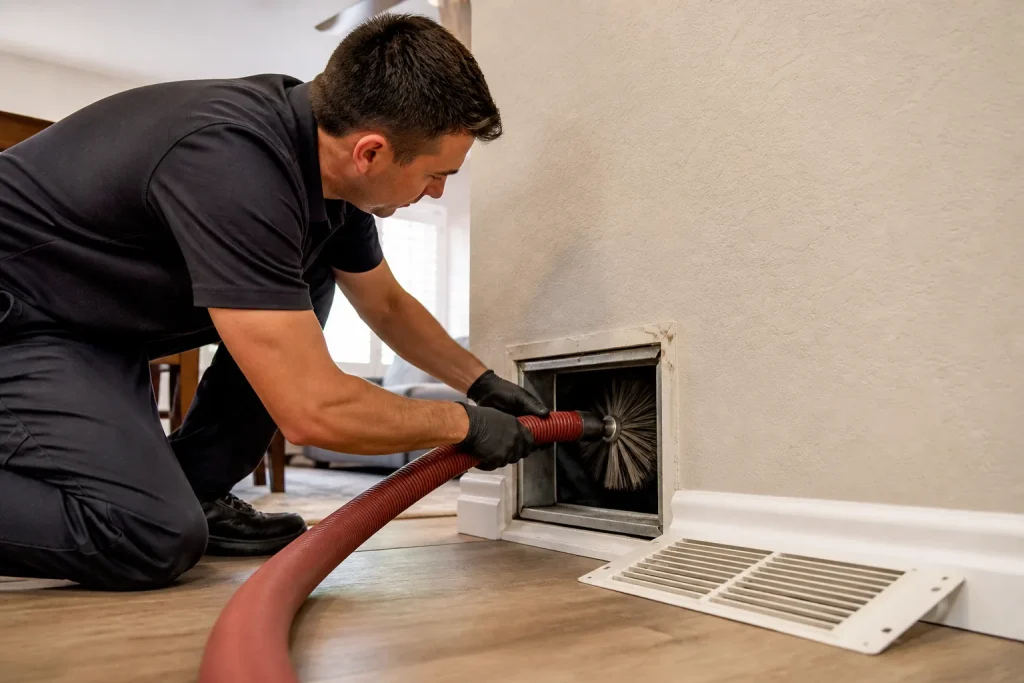
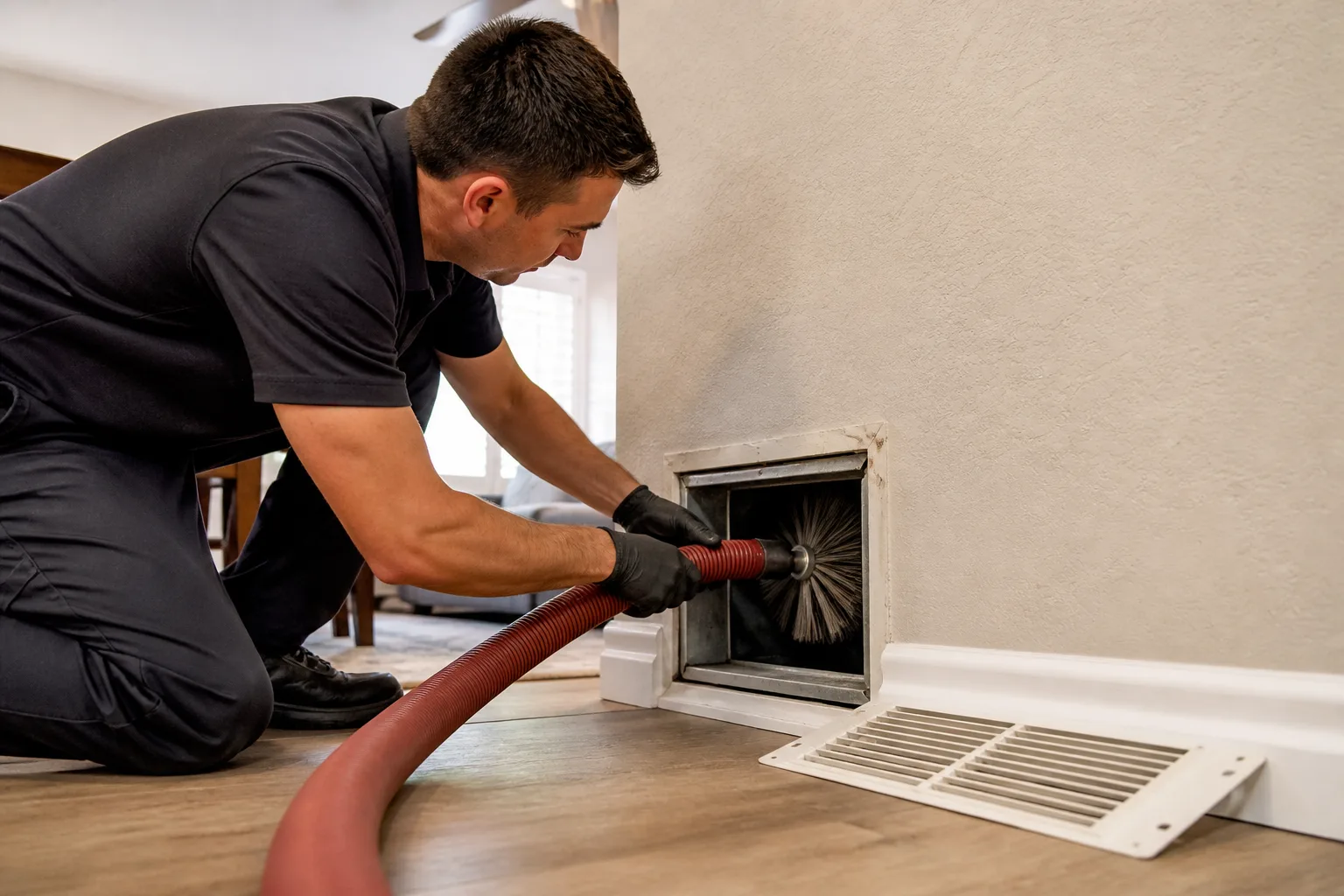
Nikro equipment does three jobs at once: it pulls the duct system under negative pressure, it agitates dust off the duct walls with a rotating brush, and it traps what it loosens in HEPA-rated filtration. Negative pressure means the whole system is held under vacuum so debris travels toward the machine instead of drifting into your rooms. Brush agitation matters because dust clings to duct surfaces; suction alone glides right past it. HEPA filtration catches fine particles before the exhaust air leaves the unit. In plain terms, one machine is doing the work of three, and each stage depends on the others to work.
Contrast that with a shop vac or a carpet extractor pressed into duct duty. Those units move air, but they don’t generate enough static pressure to hold a whole trunk line under vacuum, and their filters aren’t rated to trap fine particulate. You get a lot of noise and a modest improvement in the rooms closest to the register.
We use Nikro and Rotobrush systems on every job because they’re the same class of equipment trusted by commercial and remediation contractors. That’s not a sales line; it’s the reason the work holds up under inspection.
How can you tell a company is really using Nikro equipment?
You can verify the equipment in about two minutes by looking at the machine itself. Nikro vacuum units carry visible serial plates, are typically skid-mounted rather than handheld, and their vacuum hoses run noticeably larger in diameter than a shop vac’s. Ask to see the unit before work starts. A legitimate operator will show you without hesitation.
Here’s what to look for:
- Serial plates and brand markings on the vacuum unit and the brush tool. Nikro labels its equipment clearly.
- Skid-mounted configuration for the vacuum. Portable, handheld machines are a different class of tool.
- Hose diameter. Commercial duct hoses are thick and heavy; a garden-hose-sized line is a sign of consumer gear.
- HEPA filtration on the exhaust. Ask where the filtered air goes.
- A pressure gauge or manometer in the setup. A technician who understands negative pressure will talk about it without prompting.
If a company can’t or won’t tell you what machine they’re bringing, that’s your answer. Our technicians have up to experience, and every one of them can name the equipment they’re running and explain why.
Why does HEPA containment matter more in Peoria homes?
HEPA containment matters in Peoria because many homes here sit on slab foundations, which means there’s no basement or crawlspace for debris to settle into. When a duct is opened, whatever’s inside has two places to go: into the vacuum or into your living space. A HEPA-rated unit makes that a one-way trip.
This is worth understanding in the desert Southwest specifically. Fine dust here is a fact of life, and ducts collect it steadily between cleanings. In a home with a slab foundation and a sealed envelope, that accumulated dust has no escape route. A cleaning that agitates debris without trapping it just redistributes the problem.
In our experience, homes in Peoria with recent renovations, pest activity, or a musty smell in the return air are the ones where containment matters most. Post-construction jobs carry drywall dust and construction debris; pest issues leave behind material you don’t want aerosolized. This is where Abatement Technologies air equipment earns its place on a job. It’s built for contamination-level work, and it’s the kind of gear most residential cleaners simply don’t carry.
For heavier contamination scenarios in Peoria, we bring that equipment along. It’s part of air duct cleaning done to a standard that holds up, not just a pass with a vacuum.
What does a Nikro-equipped cleaning look like, start to finish?
A Nikro-equipped cleaning follows a clear sequence: setup, containment, agitation, extraction, and a final walkthrough with photos. Knowing the order helps you spot when a job is being cut short. Here’s what a normal visit looks like from your side.
- Walkthrough and access check. The technician identifies registers, returns, and the main trunk line, and confirms where the vacuum connects.
- Containment setup. Registers are sealed and the vacuum is connected to the system. Negative pressure is established before any brush goes in.
- Brush agitation. The rotating brush works through each branch and the trunk, loosening debris from the duct walls while the vacuum holds it.
- Extraction and filtration. Loosened material travels to the HEPA-filtered unit. Exhaust air is filtered before it leaves.
- Inspection and photos. A before-and-after look at the ducts themselves. You should see the difference, not just hear about it.
- Wrap-up. Registers are resealed, the system is checked, and any duct damage found during the job gets flagged.
That last point matters. Ductwork often has gaps, crushed sections, or disconnected joints that only become visible during cleaning. Repairing those is a separate job, but a company that can handle both saves you a second search. It’s one call for cleaning and repair, and we’ve found that’s the difference between a cleaner and a specialist.
What should you ask any duct cleaning company before booking?
Ask about equipment, containment, and what happens if damage turns up. Those three questions separate a specialist from a generalist, and the answers tell you whether the quote is honest. Use this checklist as a buyer before you commit:
- What machine will you bring? A brand name is the right answer. “A big vacuum” is not.
- Is the system held under negative pressure during cleaning? The answer should be yes, and the technician should explain how.
- Is the exhaust HEPA-filtered? This matters most in homes without a basement to catch debris.
- Will I get before-and-after photos? If the work is real, the photos are easy.
- What happens if you find damaged ductwork? A company that only cleans will hand you a referral. A specialist can repair it.
- Is the price per system or per vent? Per-vent pricing is how low quotes climb once the technician is on site.
We clean it, repair it, and improve air quality from a single visit. That’s the whole point of a specialist, and most homeowners in Peoria figure it out the second time around. If your ducts need more than a cleaning, dryer vent cleaning and duct repair are part of the same scope.
When should you call a pro instead of waiting?
Call a pro when you smell something musty from your registers, when visible dust puffs out at startup, or when a renovation or pest issue has left debris behind. Those are trigger events, not maintenance items. A professional cleaning with commercial-grade equipment is the right move when contaminants are involved.
For homeowners in Peoria, our team can assess the system and recommend the right scope. Don’t wait for symptoms to get worse: dust that settles in the ducts will keep circulating every time the system runs. If you’re not sure whether you need cleaning or repair, that’s a conversation worth having before the problem grows.
What you don’t need is a cheap quote that balloons on site. A written estimate per system, agreed before work starts, is the standard to hold any company to.
The Bottom Line
Knowing what’s in the machine is the difference between a good cleaning and a guess. Nikro equipment gives you negative pressure, brush agitation, and HEPA filtration in one setup, and those three things are what actually move debris out of your ducts. Verify the equipment, ask about containment, and insist on before-and-after photos. Everything else follows.
If you’re in Peoria and want the job done right, duct cleaning Peoria serves homeowners and property managers with professional Rotobrush and Nikro systems. Estimates are free, the price is set per system by the written estimate, and we’re licensed and insured. Call (844) 834-5310. We answer 24/7. Fast dispatch from 7am to 7pm, Sunday through Friday.
Frequently Asked Questions
Cost depends on the number of systems, duct layout, and level of contamination, which is why the written estimate sets the final price. Call (844) 834-5310 for an exact quote; estimates are free.
Cheaper quotes usually mean consumer-grade vacuums, no HEPA containment, or per-vent pricing that grows once the technician arrives. Commercial equipment costs more to run, and the difference shows up in what actually gets removed. Call (844) 834-5310 to compare a real estimate.
Ask for before-and-after photos of your own ducts and watch the setup happen. If a company can’t show you the machine or the results, the work is unverified. Call (844) 834-5310 to schedule a walkthrough.
Most homes benefit from cleaning every few years, sooner after renovations, pest issues, or persistent dust and odor. There’s no universal schedule; your system’s condition drives the answer. Call (844) 834-5310 and we’ll help you decide.
Written by the team at Duct Cleaning Peoria.
Need Air Duct Cleaning Help?
Call Duct Cleaning Peoria - licensed & insured, with free written estimates in Peoria.
(844) 834-5310